
 |
|
At a graduate student party in a Hyde Park apartment, John Bellairs first told his friends the story about his miraculous discovery of Saint Fidgeta, the patroness of nervous and unmanageable children.
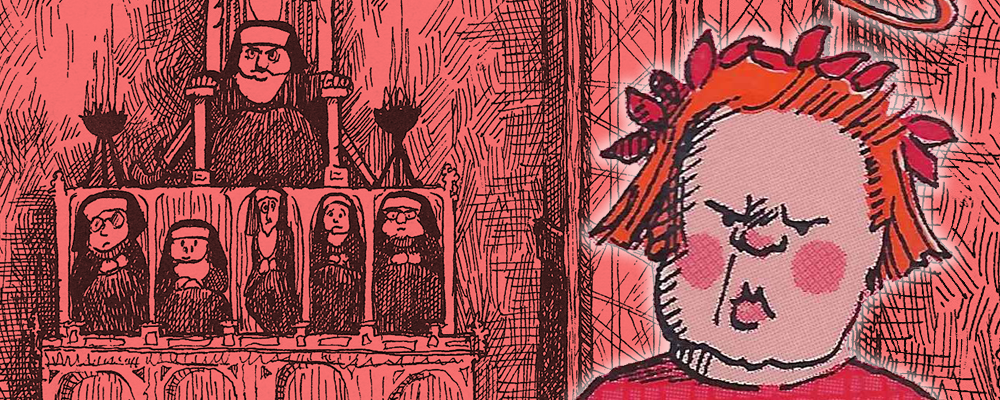
Partly inspired by his Catholic upbringing as well as his teaching at a girl's Catholic school, the character first appeared in the June/July 1965 edition of the Critic. The following year, the article became the first of twelve chapters of his first book, published in June 1966. All illustrations are by Marilyn Fitschen. |
 |
 |
 |
Why does a Christian cross himself? Answer, according to a wax tablet with Saint Fidgeta’s name, “To get to the other side.” (They did say something was lost in the translation....)
Wow, the Cathedral of Gorboduc began in 623 and was finally completed in 1962.
|
 |
Ouch! – St. Fidgeta was slapped to death. And to that we say "Ouch!" again, sir.
What better way to get some money for the parish than to “Raffle Your Grandmother Out of Purgatory.”
|
 |
St. Fidgeta is the patroness of nervous and unmanageable children. Her shrine is the church of Santa Fidgeta in Tormento, near Fobbio insouthern Italy. There one may see the miraculous statues of St. Fidgeta, attributed to the Catholic Casting Company of Chicago, Illinois. The statue has been seen to squirm noticeably on her feast day, and so on that day restless children from all over Europe have been dragged to the shrine by equally nervous, worn-out, and half-mad parents.
In 1959, the name of St. Floradora was silently dropped from the Roll of Saints, but the pandemonium that followed this decision was far from silent. Embittered Irish Catholics razed the Shrine of St. Floradora at Ballyspitteen and used the rubble to derail the night train from Belfast. And in Chicago, the twelve churches names for the now disgraced saint were hastily rededicated to St. Nymphadota, a third-century ascetic from Leptis Magna who lived for thirty years in a hollow tree, subsisting on a diet of deathwatch beetles.
|
|
|
|
| |
|
|
 |
|
|
|
The story of St. Fidgeta was published in the June-July edition of the Critic, in 1965.
The book was titled, at one point, The Grand Central Schism and Other Parodies for Catholics.
St. Fidgeta orignally cost $2.95, as shown on the inside flap of the book jacket; today, having been out of print for decades, it commands high prices from most online booksellers.
St. Fidgeta was chosen as a representative of parody for a Shimer College Humanities course. Bellairs taught the class during the spring 1967 semester, part of his one year teaching at the small Illinois college.
The character of Saint Fidgeta has a cameo in The Pedant and the Shuffly.
Marilyn Fitschen relates a story that twenty years after publication, a copy of the book was found in an abandoned missionary cottage on an island off the coast of Borneo.
The photo of Bellairs seen on the back flap of the dust jacket was the only picture of the author to ever appear on one of his books.
Jacket design for the book was by Loretta Trezzo.
|
|
| |
|
|
| Did you know: the story of Saint Dragomira bears a...uh...“striking” resemblance to the story of Good King Wenceslas? |
|
|
| |
| Statistics |
Author: John Bellairs (28)
Published: June 1966
Publishing history
Chapters: 12 | Pages: 123
Awards | Reviews | Annotations |
| |
| Adaptations |
There are no known adaptations of this work. |
| |
| Allusions |
William X. Kienzle's book Death Wears a Red Hat (1980) alludes to St. Fidgeta, specifically the story of St. Pudibunda as seen in chapter one.
|
| |
| Dedication |
I would like to thank my friends, Dale and Marilyn Fitschen, for all their help. They suffered through endless readings from the Urtext and gave me many suggestions and ideas. I would also like to thank my friend Bernard Kent Markwell, to whom St. Fidgeta first appeared on rainy day in front of the Oriental Institute in Chicago. He was struck to the ground by the vision, and after he had rolled about for a bit, he got up and told me what he had seen. He also gave me many ideas: in fact, if you do not like some part of this book, you may attribute it to him.
John Bellairs, December 1965. |
| |
 |
Book feed |
|
|
|
|